Friday, 29 February 2008

Leap Years and Mothers..

Today's the 29th of February and as ever there's much in the media about what today might mean. The BBC is wondering who owns today? And the four-yearly ritual of trotting out the tradition that this is the only day on which a woman can propose marriage will be all over the media. As Simpson and Roud observe in their Dictionary of Folklore:

it is probably true to say that younger English people would not be aware of the belief if the media did not run features on the subject every fourth February


'The Ladies' Privilege' is said to have originated with St Bridgit, who haggled St Patrick down from once every seven years to once every four. There is no evidence of any legal basis at any time for a penalty for the man refusing, despite myths to the contrary!

Today's also the day to try not to forget Mother's Day, if your family is one that marks it. This is also the subject of a number of myths. Ronald Hutton convincingly sets forward a geographical basis for an English custom called 'Mothering Sunday', to the west of the English Midlands, stretching south to Devon and Cornwall and north to Lancashire. The earliest references to this are from seventeenth century Worcestershire and Gloucestershire and suggest a visiting custom, bringing food to mothers, especially widowed mothers at a difficult time of year. The warmer weather after Winter made travelling more possible; the colder weather through Winter made want more likely.

The food brought to ease this want appears to have been a Simnel Cake, made from the best flour. These days, those who make Simnel Cakes generally produce them for Easter Sunday - packed full of leftover Christmas mincemeat and lumps of marzipan. We'll be making one for Easter.

The modern Mother's Day bears only a peripheral relationship to the older 'Mothering Sunday' traditions. It has its origins in the USA and more specifically in the devotion of a Miss Anna Jarvis of Philadelphia towards her own mother. Her agitating for a day set aside to celebrate motherhood bore success in 1913 when the American government set aside the second Sunday in May. This custom came over to Britain during the Second World War in all likelihood, when American troops were stationed here. The commercial promotion of the day in the UK led to its adoption nationwide during the 1950s. A lingering memory of 'Mothering Sunday' influenced its date here and probably eased its acceptance as a domestic custom.

Do buy a card or some flowers if you've still got time - or at least make a note to call your mum on Sunday..

Monday, 25 February 2008

Lent Beers

We're used to year-round availability of specialities that were previously only around at a particular time. You can buy hot cross buns at the supermarket in November; there's no more waiting until Easter for Cadbury's creme eggs. These might be fairly trivial examples given the power of the supermarket system to remove any connection between what we eat and the time of year - but it's all part of a gradual (or not-so-gradual) dismantling of the way in which the passage of time is reflected in our activities. This sort of thing goes hand in hand with the ongoing elimination of locality when it comes to food. So this post is going to introduce some beer specialities that are seasonal and, often, very local - drinks that I might have tracked down here and there, and others that will require a trip to the area of production at some time in the future. I'll start with a couple from Germany and occasionally add more as we go through Lent.

According to Roger Protz' rather patchy coffee table book The Taste of Beer, the German Doppel Bock is a strong beer based on brews originally produced in monastic communities for consumption during Lent. The German Beer Institute broadly agree with this. The most widely-available example that I've seen is the 'Salvator' produced by the Paulaner brewery in Munich. If it is tapped on St Joseph's Day this year (19 March), there won't be much time to drink it in what remains of Lent! Augustiner's Maximator Doppelbock, a potent, dark and spicy brew, is available now and is also highly recommended.

One beer that I am slightly obsessed with trying would require a trip to the beautiful city of Bamberg in Franconia, sometime between Ash Wednesday and Easter. It's a long way to travel from the UK, especially with two children in tow and if you want to avoid flying. So it's definitely one for lots of planning for the future. The weather during February is obviously another factor - as you can't spend *all* day in the pub! When we visited Bamberg six or seven years ago, one of the brewpubs we visited was the premises of Schlenkerla brewery - which produces probably the most famous and widely-available 'smoked' beer. It's very much an acquired taste and gets this taste from the practice of smoking the malt over beechwood. I love the stuff: but I've never tasted their Fastenbier (Lent Beer - pictured above). As you can see from the link, it's only available on draft on the premises (and the Americans get a few barrels, it seems) and it sounds wonderful. It appeals to the same rationale that increased the strength of the Munich Doppelbocks - being an indication of its nourishing qualities during the period of fasting. One day...

Monday, 18 February 2008

A delicious winter 'instant' pickle

It appears that British cauliflowers are under threat because farmers are making a loss on the crop due to weather conditions last year & the pricing policies of supermarkets. This is a great shame because it is such a fantastic versatile vegetable. We enjoy it in cauliflower cheese (of course!), in soup and with pasta or baked with tomatoes & feta. It is also delicious cold, as a crudite or with a salad. Our favourite use for it has got to be in Indian food as we experienced this weekend. It is so delicious as part of a potato & cauliflower curry or cooked simply with mustard seeds.

At the weekend I wanted to create a side dish to serve with a Madhur Jaffrey recipe for Lamb Shanks with Yogurt sauce. This is from her book The Ultimate Curry Bible which is well worth while getting hold of - it's informative & has some very straightforward recipes family-life friendly (i.e. not too much chopping, crushing, slicing & grinding) recipes.

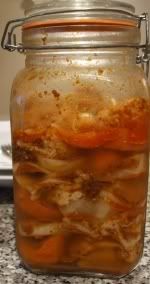
Flicking through the same book I came across a recipe for Instant Punjabi-style Pickle (which you can find here on the BBC Good Food site), which is satisfyingly seasonal - using cauliflower, carrots & turnips as its base ingredients. I also liked the idea of making a pickle that would keep but could also be used immediately. Interestingly the veggies are not cooked for very long at all so retain a real crunch which makes a pleasing contrast in texture when served with other curries. I was a bit worried by the idea of almost raw turnip, but it is actually delicous & has a sweet, mustardy flavour. I guess I would call this a relish rather than a pickle, but it certainly is very useful to have a delicious side dish all ready to go in the fridge. Not that I think this particularly jar full is going to last very long at all.

Thursday, 14 February 2008

Saint Valentine's Day

In England, today has been a day dedicated to romantic love at least since Chaucer's time, who wrote a poem depicting rival bird-suitors quarreling. This reflects one of the origins for customs at this time of year: the belief that February the 14th was the day birds began mating. Maybe this is an indication of seasonal change, but there's certainly been amorous activity throughout February in our garden - particularly a very keen pair of chaffinches.

Simpson and Roud make the sensible suggestion that it is a seasonal festival first and foremost, counting as the beginning of Spring in the French region in which it originated. The connection with Saint Valentine is, then, coincidental and not based on anything in his life. In the eighteenth century, during the craze for connecting Christendom's festivals to pagan antecedents, it was supposed that it was a survival of the Roman festival of Lupercalia (held on the 15th of February). There's next to no evidence for this and a very big gap full of nothing but silence until the fourteenth century.

It's a day for the young - for those youthful passions that make old gits like me wonder how we ever had the energy. There is a huge commercial machine ready to provide you with all kinds of tat to inflict on a loved one. It's also been co-opted by couples (or they have themselves become co-opted by the merchandising) as a 'special day' to celebrate their relationship. And when we were young, there was a non-romantic tradition of parents sending their children a Valentine's card and vice versa. Calling this a tradition would probably require more than two people having experienced it, mind you! And I have no idea if this still happens.

Like many seasonal festivals, it's an excuse to eat and drink something nice. In our opinion it's a better idea to put your cash towards something special, rather than buy some icky soft toy, rubbish flowers or embarrassingly inappropriate underwear. If you're getting flowers, try freesias rather than roses - given that commercial roses are grown scentless these days to help them to last longer. If you're getting champagne get a good one - the Billecart-Salmon pink champagne is the best, imo, but Laurent-Perrier rose is also very good. And don't buy teddy bears. Naff and a bit weird, we think.

Our treat is some food from Le Panier Mignon deli in Cambridge. Some lovely ciabatta that we're going to fill with red pesto, parma ham and mozarella and then bake in foil in the oven. With this we've got something pink to drink - the rather rare Drie Fonteinen 'Hommage'. This is a lambic beer infused with Payottenland raspberries and a few cherries. We've never had it before so we're very much looking forward to it.

Tuesday, 12 February 2008

Sloe Gin Martini

I've been trying over the last couple of evenings to get close to a good recipe for a martini using sloe gin. It doesn't seem so long ago that we were cycling down the river Cam to find the Blackthorn tree we know and picking enough sloes to steep in gin for Xmas presents and a bit left over for us too. It's just coming into its own now and is a nice cheery drink for February - this cocktail would also make a nice treat for Valentine's Day if you have the relevant ingredients and your budget doesn't run to a bottle of, say, Billecart-Salmon rose champagne. It's certainly quite pink.

The amount of vermouth used will always be variable according to your taste. I tried it with 1/4 of a measure last night, but that was a bit much for me. And I use a very strong-flavoured and dry vermouth, the exemplary Dolin from Chambéry. If in doubt, use a smaller amount, taste it and adjust your next attempt upwards or downwards accordingly.

The recipe's really simple, just like a classic martini with one extra ingredient, so:

1/2 measure dry gin (I find Plymouth Gin's great for cocktails)
1/2 measure sloe gin
1/6 measure dry French vermouth

shake all ingredients over ice and strain into a cocktail glass, or a wine glass if you're lazy like me (see picture!). Enjoy!

Thursday, 7 February 2008

Forced Rhubarb

It was a welcome splash of colour at this time of year, seeing bright bunches of rhubarb for sale on the fruit stall at Cambridge's Sunday market this week. Yorkshire is famous for this delicacy: it takes centre stage at Wakefield's food festival which is being held this year on Friday the 7th and Saturday the 8th of March. Sadly we missed the National Rhubarb Pie Day which was this year apparently on the 28th of January. It's listed along with other international rhubarb festivals here.

Most of last Sunday's rhubarb is now steeping in vodka and sugar and will undergo a gradual transformation into some delicious rhubarb 'schnaps'. The plan is to keep this until next Christmas and give it to people as a gift. If we manage to leave it alone for that long it'll be some achievement - as will organising our first Christmas 2008 preparations in early February!

The recipe given to us by a friend - which she said is taken from Nigella Lawson - is:

1 ltr vodka
600g trimmed & chopped rhubarb
300g caster (preferably) or granulated sugar

Put all ingredients into a 1.5 or 2 litre jar. If you're using granulated sugar, give it the occasional stir to dissolve. Close the jar lid and store for 6 weeks - 6 months. Shake every other day in the first month. After this, strain into a jug and pour into bottle(s). It will continue to mature and improve for a few months in the bottle.


Very nice mixed with ginger beer!

Another seasonal treat we've enjoyed is a brace of partridges, braised with January King cabbage according to a lovely simple recipe in Keith Floyd's A Feast of Floyd. This is a great book, packed full of great recipes that's amongst our favourites because of how useful it's been. It's out of print, but seems to turn up regularly, very cheaply on Amazon marketplace or Abebooks.

Tuesday, 5 February 2008

Shrove Tuesday

Pancakes for breakfast this morning. But not the standard British variety with lemon juice and sugar, which are frankly a bit dull. So we turned to the recipe from Nigella Lawson's Feast book for buttermilk and banana pancakes, smaller American-style numbers which turned out to be totally delicious with the quince and bramble jellies we made last Autumn and equally tasty with some maple syrup and my mum's blackcurrant jam. The four of us got through quite a number of them this morning.

The practice of making pancakes is well-known to have been a way to use up perishable foodstuffs before the onset of the fasting period of Lent, which begins tomorrow on Ash Wednesday. According to Simpson and Roud's Dictionary of English Folklore, the Monday before the beginning of Lent was known as 'Collop Monday', due to the practice of eating 'collops', fried or boiled cuts of meat. The eating of meat (as well as eggs and cheese) was then banned until communion had been taken on Easter Day, for most people in medieval England the only day on which they would take communion.

Back to pancakes, the first reference is from William Warner's Albion's England (1586), quoted by Ronald Hutton in Seasons of the Sun, as well as by Simpson and Roud, a description of 'Fast-eve pan-puffs'. Our pancakes this morning were certainly more like 'pan-puffs' than the thin versions we're mostly used to!

As well as the feasting, which eventually became this pancake tradition, there is a long-standing connection between violence, playful and serious, and Shrovetide. This violence is particularly expressed in the history of public ball games, a violence which also from the reign of James I onwards in certain places spilled over into rioting. From the very end of the sixteenth century, the City of London saw frequent riots for which apprentices appear to have been responsible. The growth in forces to keep the peace in London led to a decline. Other cities also saw carnival-esque misbehaviour, as in the following example from Bristol which Hutton describes:

Shrove Tuesday revelry by youth became an issue at the realm's second city, of Bristol, where annually during the Interregnum the magistrates (clearly without avail) forbade the apprentices to throw at cocks, play football, or (as another opportunity for cruelty) toss dogs in the air. The lads eventually wove these sports into a political protest, for on Shrove Tuesday 1660, when demonstrations against the tottering republic were breaking out all over southern England, they used the letter of the prohibition to insult the republicans who ran the city. Outside the mayor's house they threw at geese and hens and tossed up bitches and cats, and knocked down the sheriff who tried to prevent them. (Seasons of the Sun, p. 156.)


These kind of breakdowns of order, and their ritual aspect - which Hutton describes as 'licensed misrule', are reminiscent of continental celebrations and carnival at Shrovetide, like the German and Austrian Fasching. Tossing a few pancakes and thinking about whether to give up chocolate for Lent are the mild relics of our wilder history.

Saturday, 2 February 2008

Candlemas

Today's the day you should really have your Christmas decorations down - in the unlikely event they've lasted this long! Robert Herrick in the seventeenth century described how it marked the end of festivities, the time when greenery was removed and the Yule Log was finally quenched.

In medieval England, it was an occasion on which the bond between parishioners and their church was re-established and confirmed: each parishioner bringing a candle in procession as an offering and returning home with blessed candles for protection against various ills. The festival and its accompanying performative celebration were banned in England in 1548 by the Duke of Somerset at the beginning of Edward VI's reign. Although the festival remained in some places during the reign of Elizabeth I, its more general celebration in England had to wait until the Anglo-Catholic revival of the nineteenth century.

Like other traditional customs suppressed during the Reformation, the exchange and lighting of candles may have passed into private domestic folk customs, separated from their origins as public ritual. It is difficult to argue this to any great effect, as the references to candle lighting at Candlemas from the eighteenth and nineteenth centuries are too distant from the pre-Reformation customs to present a convincing continuity.

The beginning of February needs something to cheer it up though, as Ronald Hutton points out in 'Seasons of the Sun':

Their [Candlemas & St Blaise's day on the 3rd, important to the wool trade] disappearance left Britain bereft of any national festivals formally to mark the traditional end of winter and the opening of spring. [...] February became for most people a friendless month, too far after Christmas and too long before Easter (Seasons of the Sun, p. 145)


- and Spring was certainly in the air in our garden this morning judging from the amorous chaffinches dashing through the sky and competing with other birds at the feeders. We even saw a wren, which was very exciting as neither of us had seen one before. Lighting a candle or two at the beginning of February and maybe starting to plan jobs to get on with in the garden are two simple ways to mark the approach of Spring, however cold and inclement the weather outside might be.

Music for The Feast of the Purification

Today is Candlemas and in the church year is the day which commemorates the biblical story of the child Jesus being lost and then found in the temple. It is a story which produced one of the great christian liturgical prayers, the Song of Simeon or Nunc Dimittis.

This text provided Johann Sebastian Bach with the basis for one of his most famous and well-loved cantatas, BWV 82 'Ich habe genug'. It was originally composed for solo bass voice (Bach also made a transcription for soprano) and features a prominent oboe part (a flute in the soprano version). It consists of three arias which differ in character from each other and are connected together by two short recitatives. The opening aria features, to my ears, a perfect musical evocation of yearning, portrayed by strings, oboe and the voice. The second is a lullaby for this weary soul, while the third a confident joy in the face of death. It's a simple progression of ideas put across musically, each bridged by recitatives which expertly change the mood. It's also a piece of music that our two children have grown up with, one of the pieces we most often play while preparing for bedtime - they both like it (as far as we can tell!) and seem sensitive to differences in performance

There is a bewildering number of recordings available of this cantata. I've picked out three which I find myself returning to more often than the others, but it is almost entirely a matter of personal taste. It's music that players and singers tend to rise to the challenge of in my experience. The big gap in my collection is any version by Dietrich Fischer Dieskau - who recorded three versions as you can see from his short biography at bach-cantatas.com. The earliest recording I have is by Hans Hotter on EMI. Recorded in 1950, Hotter's vocal performance is extraordinary, but it's not a version I listen to very often as the instrumental accompaniment and overall feel is a little offputting in its romanticism. The most recent is diametrically opposed to Hotter's version, featuring a lighter, more lyrical touch from bass Stephan MacLeod on the ATMA label. as part of their traversal of Bach's cantatas singing one voice per part (a performance decision which doesn't apply in the case of a solo cantata like this!). I like this very much for its freshness and MacLeod puts in a very good performance


My favourite recording is the CD made by Sigiswald Kuijken and La Petite Bande with bass Klaus Mertens from 1993. Marcel Ponseele puts in a particularly strong performance as the oboist on this version and Mertens is totally responsive to the text, managing the various transitions in mood and effect. Sadly, this now appears to be out of print - neither Amazon nor MDT have it listed, which is something that's happened in the last couple of years. We can hope that Accent are considering re-releasing it. Kuijken recently re-visited this cantata with bass Jan van der Crabben as part of his partial cantata cycle. Van der Crabben's voice doesn't quite match up to Mertens for me, but he certainly doesn't let down the wonderful accompaniment by oboist Patrick Beaugirard and the other members of La Petite Bande. The sound is wonderfully clear and intimate - an intimacy which is also present in van der Crabben's performance. It's a recording that I keep returning to with increasing pleasure - as with the other instalments in Kuijken's mini cycle.

Ponseele also played oboe for Philippe Herreweghe's 1991 recording with Dutch bass Peter Kooy. In the absence of the 1993 Kuijken version, this would probably be my first choice, although it's a close decision. There is a beautiful sheen to Herreweghe's version, a luminous quality to the strings, which still keep a rhythmic discipline that prevents the sound from becoming too smooth. The oboe and strings in the opening aria have a tender, yearning quality and a firm forward momentum into the rest of the cantata. Kooy is a particularly accomplished singer of Bach's sacred music: he is the bass favoured by Masaaki Suzuki (who is yet to record this cantata in his cycle) and is an experienced soloist in the passions: here, he brings a restrained emotional depth to the performance which is particularly affecting. The disc also includes two other cantatas for solo bass, each performed to a similarly high standard.


One recording of Klaus Mertens performing this cantata is still available, which he made in 2001 with Ton Koopman as part of the Dutch conductor's complete cycle of Bach cantatas. It's a stylish performance - Koopman's organ accompaniment is carried off with a good deal of panache and Mertens, while not to my ears as sublime as he was eight years previously, rises to Koopman's stylistic requirements with great credit. The central 'lullaby' aria 'Schlummert ein..' is taken at a tempo which I suspect some will find a little brisk, but the interweaving of Mertens' voice, Koopman's organ, the continuo and strings is beautifully set out and fascinating to listen to. The final aria shows Koopman and Mertens at their strongest - vivid, bright and with a driving intensity.

Two honourable mentions to finish this post. John Eliot Gardiner's live recording from his cantata pilgrimage in 2000 is available on Deutsche Grammophon, featuring bass Peter Harvey. It makes a nice contrast to Koopman, in that Gardiner slows the pace of 'Schlummert ein..' down noticeably. Because it's live it doesn't have the sheen of perfection present in many of the studio recordings, which is not something that concerns me and gives an 'edge' which I like very much. I'm a big fan of Gardiner's cantatas - not least because his recordings were the first I heard - and Peter Harvey as well and both are in their usual good form here. The contrasts are especially rewarding, the serenity of the lullaby the calm before Gardiner whips up a storm in the final aria.

Finally, I only have one recording of the transcription Bach made for the soprano voice (BWV 82a) - by Karina Gauvin with Bernard Labadie and Les Violons du Roy from 2004 - and it always takes my ears a little while to adjust! Gauvin's silvery voice sets the music in a very different light to a bass as you might imagine and lends the cantata a more ethereal quality. I'm not convinced by it, but that's probably because I haven't heard enough recordings to come to any firm conclusions.

I've missed out lots of others. I liked Thomas Quasthoff's version, but it's a while since I heard it; and I've not heard the recording by Matthias Goerne which is very well thought of. And as I said earlier, I don't have any versions by Fischer-Dieskau - as I never tire of hearing this music, I can see my modest collection of recordings only increasing over time...

Friday, 1 February 2008

1st February - St Brigid's Day


Brigid was supposedly first abbess of a double monastery (for men and women, but mostly for women) in present-day Kildare in Ireland and she is a saint who has always attracted a good deal of legendary material. Reliable sources for her life are exceedingly sketchy and for some they do not even support her existence. The first biography was composed around a century after she is supposed to have died, by a writer called Cogitosus (for much of these details - and much more - see this article by Lisa M Bitel, full reference below, from p. 211 for the biographies). Two further anonymous Lives followed Cogitosus in the subsequent fifty years.

It is these two subsequent Lives which introduced a number of elements of pre-Christian Ireland which have gone on to prompt speculations that Brigid was somehow a pagan goddess claimed by the church. This is stretching the evidence to breaking point. What is interesting is that the eighth and ninth-century Lives wrote with a degree of freedom that allowed pagan content to be introduced into the saint's Life. This material established a connection between the saint and the natural world and tied her in to themes present in secular literature, which sought to evoke a pre-Christian past. These two hagiographers, as Bitel points out, lacked the saint's body, present in Kildare, and appear to have attempted to invoke connections with nature and a kind of patriotic nostalgia for the pre-Christian past in order to claim a saint to whom they lacked direct access.

By around 900, when Cormac mac Cuilennain wrote concerning Brigit, the connection with pre-Christian deities was still clearer, as appears to have been the case with ninth century writings concerning a goddess called 'Brig' (for both of these sources, see Bitel, p. 224). The two hagiographers who followed Cogitosus had started a process which then produced something of a creative explosion of pre-Christian beliefs, the nature of which remain steadfastly unclear.

These speculations are given a further spin by the situating of her feast day on a day, Imbolc, which was of significance to the pre-Christian inhabitants of Ireland. What this significance was - or whether any of its meaning persisted - is unclear, as the early medieval writers who mention it show no evidence of understanding - or being interested in - its significance. A good summary of the evidence can be found in Ronald Hutton's excellent Stations of the Sun. Putting aside any speculation as to a mystical significance to the date of Imbolc, it is of primary importance for the way it marks the seasons changing. Spring seems a long way off at the beginning of February, but at Imbolc according to a tenth or eleventh-century writer (of the Tochmarc Emire from the 'Ulster Cycle', see Hutton, p. 134) the ewes would be milked at this time, at the beginning of spring (originally a couple of weeks later before the calendar was reformed).

Imbolc continues to be an important date for neo-Pagans, following the enthusiastic interest in Celtic traditions and customs. In Britain, outside those areas of strong Irish influence, the key date for the end of winter and the beginning of spring was, however, Candlemas - which is tomorrow.

==========
Full reference for the article referred to above: L Bitel, 'Body of a saint, story of a goddess: origins of the Brigidine tradition', Textual Practice 16(2), 2002, 209-228. It can be accessed online here.

The image at the beginning of this post is 'Saint Bride' by John Duncan (1913), a painting in the National Gallery of Scotland in Edinburgh. More details can be found on their website here. It's been included in this post as 'fair use', for the purpose of study, review or critical analysis only, and will be removed at the request of the copyright holder(s).

Winter Vegetables

The British cauliflower is in crisis because of cheap imports and the supermarkets' usual practice of driving down prices. It's also got a bad reputation as a vegetable for many, bringing back memories of overcooked, watery school dinners and bland cauliflower cheese made with cheese as grim as the vegetable was overcooked. But there's plenty you can do with this ingredient - not least two of our favourite ways: cooked in spices in Indian cuisine until nicely al dente; or baked with tomatoes, feta cheese and olive oil.

This evening we enjoyed a particularly delicious creamy soup made with cauliflower: just the thing for the end of a cold day:

1 potato
1 onion
1 cauliflower
25g butter
600ml chicken stock
2 generous tablespoons of creme fraiche
nutmeg, a couple of grinds

Chop the potato & onion and sweat in a large saucepan with the butter until the onion is transparent. Split the cauliflower into florets and add to the saucepan along with the chicken stock. Bring to the boil, cover and simmer on a low heat for 20 minutes. Add the creme fraiche and a grate or two of nutmeg, allow to cool a little and then blend. A hand blender is the easiest thing to use or you can use a liquidizer. Reheat and check seasoning.


Today was also the day for making a batch of Sauerkraut. If cauliflower's a bit of an acquired taste, then Sauerkraut is probably doubly so! Accompanying some good sausages it really comes into its own and it's a taste that's worth cultivating. Add a glass of lovely German beer and it's a simple and delicious treat. The good thing is that it's so easy and cheap to make that you can have a go without it being a real disaster. Here's what you need and how to make it:


1 white cabbage
1 tbsp caraway seeds (optional)
2 tbsp sea salt
1 litre preserving jar (see pic)

Put cabbage, caraway seeds and salt into a bowl and pound the cabbage with something heavy (like the end of a rolling pin) to release the juices from the cabbage. Pour mixture into a preserving jar with a wide mouth (see picture) then press it down until the juices come up over the top of the cabbage. Leave at least an inch between the cabbage and the top of the jar. Cover tightly and keep at room temperature for 3 days then store in the fridge. It'll be ready to eat after 3 days but it continues to develop its flavour in the fridge.

Finally, a note of a very good beer I enjoyed this lunchtime at Cambridge's Carlton Arms pub: York Brewery's 'Last Drop Beer'. A delicious stout, full-bodied with rich dark fruit and a backbone of coffee and cigar-box toastiness. Like the soup, a good way to warm up on a cold day!